
 by
by This is Part I of a series about the hormone oestrogen, to debunk myths and give current information on oestrogen at different points in a woman’s journey. In parts II and III we’ll cover roles of oestrogen, impact of oestrogen on different tissues in the body, along with best-evidence for treatment (hormonal therapy and natural therapy options.)
Introduction to Oestrogen
First and foremost, did you know oestrogen is the name for a group of hormones oestrone (E1), oestradiol (E2), and oestriol (E3)? Oestradiol is the most important of the three; and is produced by the ovaries during the childbearing years.
Normal levels of oestradiol are necessary for ovulation, conception and pregnancy.
Oestradiol is also partly responsible for healthy bone structure (along with progesterone), and cardiovascular health – but more on that in part II.
Let’s talk about oestrogen in a young woman’s life.
Menarche
The first time oestrogen becomes important is puberty, with increasing levels of oestrogen the trigger for the first ovulation and menstrual cycle. Menarche is the term given to the first bleed, which typically occurs between ages 11-14, although data from the United States of America (2013–2017) indicates that 10% of women are now reaching menarche by age 10 and 26% by age 11, compared with 7% and 21% of women in 1995, respectively.1
During menarche, levels of oestrogen fluctuate wildly, and progesterone may be slow to come online due to an immature Hypothalmic-Pituitary-Ovarian (HPO) axis. This can result in relative oestrogen dominance. What this means is that oestrogen is relatively higher than progesterone throughout the cycle in some young women, leading to irrregular periods and heavier flow early on in menstruation.
Over time, as the hormonal pathways mature and stabilise, progesterone levels will naturally increase and periods should become more manageable, and lighter for most young women.
However, there is data to suggest that early onset of menarche is linked with increased incidence of endometriosis. Retrograde menstruation (where back flow of period blood into the uterus leads to stray endometrial cells in the pelvic cavity) is proposed as the main mechanism of action for development of endometriosis; however, immune and environmental factors are also suspected. Early menarche and therefore earlier exposure to this retrograde menstrual flow, can lead to increased risk of endometriosis particularly noted in lower-income countries.2
Oestrogen in a young woman’s life is vitally important, too little can lead to period problems and poor bone health.
Delayed menstruation and lack of a monthly bleed is known as amenorrhea. This can occur in young athletes who are underweight or lacking in nutrition, and those with disordered eating; leading to lower oestrogen levels and higher bone turnover. This can have repercussions later on in life (pregnancy, postpartum, perimenopause and menopause).
Motherhood
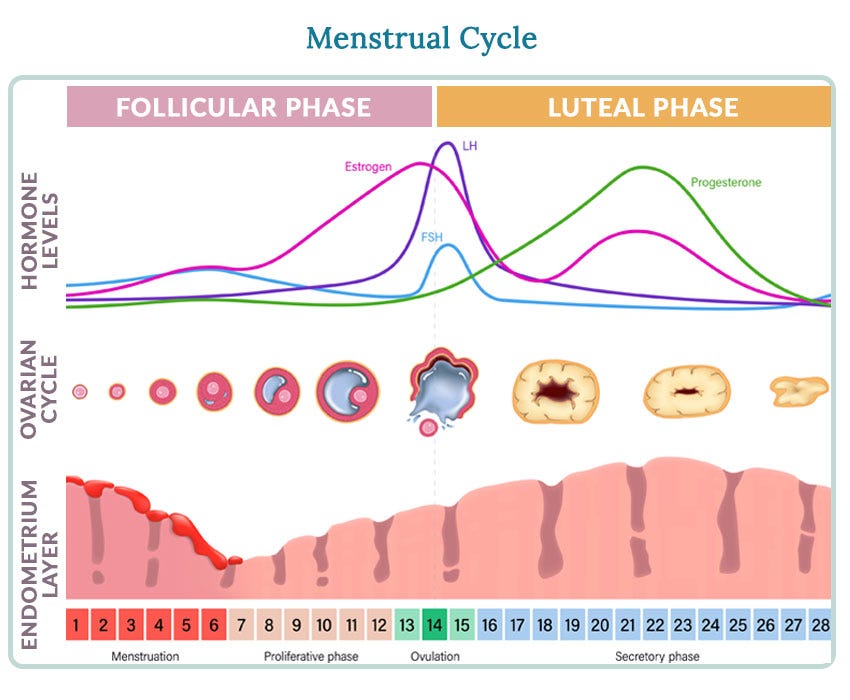
Oestrogen is paramount during menstruation and many of us are familiar with the classic monthly hormonal chart like the one below. (Worth noting here is that progesterone is not to scale in this chart and is significantly higher in amount than is shown here for convenience.)
During the childbearing years, oestrogen is responsible for the menstrual cycle, with increasing levels causing an LH surge, which triggers ovulation. This signals the release of a mature egg from the ovary. If fertilisation of the egg occurs, oestrogen then plays a crucial role as it helps to develop the placenta, maintains the uterine lining (along with progesterone) and promotes the growth of breast tissue.3
Oestrogen stays high across the pregnancy (on a side note, often why we see increased incidence of recurrent vulvovaginal candidiasis RVCC in pregnancy), as the increased oestrogen leads to increased production of glycogen in vaginal epithelial cells, which can feed opportunistic Candida spp.4,5
Oestrogen in pregnancy supports bone and organ growth of the foetus, as well as having a regulatory impact (suppressing LH and FSH) to prevent ovulation.
Postpartum
During the postpartum period, hormone levels fall rapidly and can take months to stabilise. The drop in oestrogen and progesterone has been likened to taking 100 contraceptive pills one day, and suddenly taking zero the next; (something my midwife told me in the postpartum in order to help me feel better and normalise those early mood swings.)
Prolactin is the hormone that governs breastfeeding, produced by the pituitary, it suppresses oestrogen, and therefore ovulation.
Some women will return to menstruation quite quickly after birth (within 6 weeks) while others take longer, up to 12 months or more for a cycle to return. This is nature’s protective process to give the mother time to recover from birth, and feed her baby before the demands of a subsequent pregnancy are upon her.
Low oestrogen in the postpartum can lead to similar symptoms to those women experience in perimenopause and menopause, although in more subtle ways.
Oestrogen may be lower than pre-pregnancy levels at this time, but it is still relatively significantly higher than it will be in actual menopause (when periods have ceased and oestrogen drops rapidly.)
Menopause and Perimenopause
Perimenopause is a great time of flux and contrary to popular belief it is not a time for low oestrogen but a time for wildly fluctuating oestrogen.
At the same time, progesterone also starts a slow and steady decline.
In fact, the changeable nature of the hormones in this life phase before menopause mirrors the irregularity of menarche.
Most people associate perimenopause with low oestrogen, but because progesterone is low overall, signs of oestrogen dominance can occur in this phase, with oestrogen at times being too high, relative to progesterone.
This can mean heavy periods, adenomyosis, endometriosis, fibroids and more can proliferate, causing women difficulty in this life stage. Mood swings can also occur due to withdrawal of oestrogen (when levels plummet), as oestrogen receptors in the brain are very sensitive to hormonal change.6
With the onset of menopause, things change again, and hormones become more stable. Oestrogen is lower, and made by the adrenals not the ovaries. Testosterone is relatively higher, and progesterone stable but low.
Lower oestrogen can impact metabolism, brain, bone and heart health and more.7,8 In Part III we will look at hormonal and other therapies for supporting women during these life stages. Stay tuned for Part II – Organs and Tissues Impacted by Oestrogen.
Know a friend or colleague who would love this read? Please share. This substack is a labour of love and a way to share important information that women deserve to know.
Have something to say about oestrogen? Comment below and spark a discussion!
Got a burning question about hormones? Ask me and I’ll cover it in Part II and Part III of the series.
Disclaimer – please note, this information is general in nature. If you require support with your hormones please contact your doctor or naturopath for support.
References
- Martinez, G., M, (2020), Trends and patterns in menarche in the United States: 1995 through 2013–2017, National Health Statistics Reports, Number 146.
- Lu, M. Y., Niu, J. L., Liu, B, (2023), The risk of endometriosis by early menarche is recently increased: a meta-analysis of literature published from 2000 to 2020. Archives of Gynecology and Obstetrics, 307(1), 59-69.
- Trickey, R. (2003). Women, Hormones and the Menstrual Cycle: herbal and medical solutions from adolescence to menopause. Allen & Unwin.
- Mirmonsef, P., Hotton, A. L., Gilbert, D., Gioia, C. J., Maric, D., Hope, T. J., Spear, G. T. (2016), Glycogen levels in undiluted genital fluid and their relationship to vaginal pH, estrogen, and progesterone. PloS one, 11(4), e0153553.
- Dennerstein, G. J., & Ellis, D. H. (2001). Oestrogen, glycogen and vaginal candidiasis. Australian and New Zealand Journal of Obstetrics and Gynaecology, 41(3), 326-328.
- Steiner, M., Dunn, E., & Born, L. (2003). Hormones and mood: from menarche to menopause and beyond. Journal of affective disorders, 74(1), 67-83.
- Stokes, G., Herath, M., Samad, N., Trinh, A., & Milat, F. (2025). Bone Health—Across a Woman’s Lifespan. Clinical Endocrinology, 102(4), 389-402.
- Naftolin, F., Friedenthal, J., Nachtigall, R., & Nachtigall, L. (2019). Cardiovascular health and the menopausal woman: the role of estrogen and when to begin and end hormone treatment. F1000Research, 8, F1000-Faculty.
Leave a Reply